Westminster Assembly

Westminster Assembly

Acts 6:4

"But we will give ourselves continually to prayer, and to the ministry of the Word."

..

..

1 Timothy 4:6-16

" If thou put the brethren in remembrance of these things, thou shalt be a good minister of Jesus Christ, nourished up in the words of faith and of good doctrine, whereunto thou hast attained. But refuse profane and old wives' fables, and exercise thyself rather unto godliness. For bodily exercise profiteth little: but godliness is profitable unto all things, having promise of the life that now is, and of that which is to come. This is a faithful saying and worthy of all acceptation. For therefore we both labour and suffer reproach, because we trust in the living God, who is the Saviour of all men, specially of those that believe. These things command and teach. Let no man despise thy youth; but be thou an example of the believers, in word, in conversation, in charity, in spirit, in faith, in purity. Till I come, give attendance to reading, to exhortation, to doctrine. Neglect not the gift that is in thee, which was given thee by prophecy, with the laying on of the hands of the presbytery. Meditate upon these things; give thyself wholly to them; that thy profiting may appear to all. Take heed unto thyself, and unto the doctrine; continue in them: for in doing this thou shalt both save thyself, and them that hear thee." 1 Tim 4:6-16 (KJV)
Showing posts with label Repentance. Show all posts

"ELECTION" by J.C. Ryle

Tuesday, May 1, 2012


"Knowing, brethren beloved, your election of God."— 1 Thessalonians i. 4
"Give diligence to make your calling and election sure."— 2 Peter i. 10

The texts which head this page contain a word of peculiar interest. It is a word which is often in men’s minds, and on men’s tongues, from one end of Great Britain to the other. That word is "Election."
There are few Englishmen who do not know something of a general election to Parliament. Many are the evils which come to the surface at such a time. Bad passions are called out. Old quarrels are dug up, and new ones are planted. Promises are made, like piecrust, only to be broken. False profession, lying, drunkenness, intimidation, oppression, flattery, abound on every side. At no time perhaps does human nature make such a poor exhibition of itself as at a general election!
Yet, it is only fair to look at all sides of an election to Parliament. There is nothing new, or peculiarly English, about its evils. In every age, and in every part of the world, the heart of man is pretty much the same. There have never been wanting men ready to persuade others that they are not so well governed as they ought to be, and that they themselves are the fittest rulers that can be found. A thousand years before Christ was born the following picture was drawn by the unerring hand of the Holy Ghost: —
Absalom rose up early, and stood beside the way of the gate: and it was so, that when any man that had a controversy came to the king for judgment, then Absalom called unto him, and said, Of what city art thou? And he said, Thy servant is of one of the tribes of Israel.
And Absalom said unto him, See, thy matters are good and right; but there is no man deputed of the king to hear thee.
Absalom said moreover, Oh that I were made judge in the land, that every man which bath any suit or cause might come unto me, and I would do him justice!
And it was so, that when any man came nigh to him to do him obeisance, he put forth his hand, and took him, and kissed him." (2 Sam. xv. 2-5.)
When we read this passage we must learn not to judge. our own times too harshly. The evils that we see are neither peculiar nor new.
After all, we must never forget that popular election, with all its evils, is far better than an absolute form of government. To live under the dominion of an absolute tyrant, who allows no one to think, speak, or act for himself, is miserable slavery. For the sake of liberty we must put up with all the evils which accompany the return of members to Parliament. We must each do our duty conscientiously, and learn to expect little from any party. If those we support succeed, we must not think that all they do will be right. If those we oppose succeed, we must not think that all they do will be wrong. To expect little from any earthly ruler is one great secret of contentment. To pray for all who are in authority, and to judge all their actions charitably, is one of the principal duties of a Christian.

"Flee from the Wrath to Come!" by C.H. Spurgeon

Friday, March 23, 2012
(Delivered by C. H. Spurgeon, at the Metropolitan Tabernacle, on October 23rd, 1881. No. 2704)


"Who warned you to flee from the wrath to come?" Matthew 3:7
"Who have fled for refuge to lay hold upon the hope set before us." Hebrews 6:18

We will first consider the question of John the Baptist: "When he saw many of the Pharisees and Sadducees come to his baptism, he said unto them, You brood of vipers, who has warned you to flee from the wrath to come?" I have no doubt that the Pharisees and Sadducees were very much surprised to hear John addressing them in that way; for men who wish to win disciples, ordinarily adoptmilder language than that, and choose more attractive themes, for they fear that they will drive their hearers from them if they are too personal, and speak too sharply. There is not much danger of that nowadays, for the current notion abroad now is that gospel ministers can sew with silk without using a sharp needle; and that, instead of piercing men with the sword of the Spirit, they should show them only the hilt of it; let them see the bright diamonds on the scabbard — but never let them feel the sharpness of the two-edged blade. They should always comfort, and console, and cheer — but never allude to the terror of the Lord.
That appears to be the common interpretation of our commission; but John the Baptist was of quite another mind. A Pharisee came to him — a very religious man, one who observed all the details of external worship, and were very careful even about trifles, a firm believer in the resurrection, and in angels and spirits, and in all that was written in the Book of the law, and also in all the traditions of his fathers, a man who was overdone with external religiousness, a Ritualist of the first order — who felt that, if there was a righteous man in the world, he certainly was that one. He must have been greatly taken aback, when John talked to him about the wrath of God, and plainly told him that that wrath was as much for him as for other people. Those phylacteries and the broad borders of his garment, of which he was so proud, would not screen him from the anger of God against injustice and transgression; but, just like any common sinner, he would need to "flee from the wrath to come!"

"But I Don't Have The Gift Of Evangelism"

Friday, March 2, 2012
Saying you don't have the gift of evangelism as a way of avoiding responsibility for sharing

your faith is equivalent to saying:


1. I don't have the gift of caring about the souls of other people.


2. I don't have the gift of appreciation for what my Savior did for me.


3. I don't have the gift of obedience to Christ's commands to preach the gospel and make
disciples.


4. I don't have the gift of getting out of my comfort zone to tell people that Jesus is the only
way to Heaven.


5. I don't have the gift of storing treasure in Heaven.


6. I don't have the gift of doing what all true believers should want to do.


7. I can't share a gospel that I don't appreciate because I don't possess it myself.


8. I won't share a gospel that I don't see the dire need for, since the salvation I have is not real.


9. I won't point people to Christ or warn them about hell because I am more concerned about
what people will think of me than about what God thinks of me.


10. I think evangelism is only for pastors and professional evangelists, and I am neither of
those two classes of people and I love having that excuse because I am really a false convert
who has no allegiance to the Lamb Of God.

Ray Kane

"NATURAL MEN IN A DREADFUL CONDITION" by Jonathan Edwards

Saturday, January 28, 2012
Then he called for a light, and sprang in, and came trembling, and fell down before Paul and Silas, and brought them out, and said, "Sirs what must I do to be saved?" Acts 16:29-30

We have here and in the context and account of the conversion of the jailer, which is one of the most remarkable instances of the kind in the Scriptures. The jailer before seems not only to have been wholly insensible to the things of religion, but to have been a persecutor, and to have persecuted these very men, Paul and Silas; though he now comes to them in so earnest a manner, asking them what he must do to be saved. We are told in the context that all the magistrates and multitude of the city rose up jointly in a tumult against them, and took them, and cast them into prison, charging the jailer to keep them safely. Whereupon he thrust them into the inner prison, and made their feet fast in the stocks. And it is probable he did not act in this merely as the servant or instrument of the magistrates, but that he joined with the rest of the people in their rage against them. And that he did what he did urged on by his own will, as well as the magistrates' commands, which made him execute their commands with such rigor.
But when Paul and Silas prayed, and sang praises at midnight, and there was suddenly a great earthquake, and God had in so wonderful a manner set open the prison doors, and every man's bands were loosed, he was greatly terrified. And in a kind of desperation, he was about to kill himself. But Paul and Silas crying out to him, "Do yourself no harm, for we are all here," then he called for a light, and sprang in, as we have the account in the text. We may observe:
First, the objects of his concern. He is anxious about his salvation. He is terrified by his guilt, especially by his guilt in his ill treatment of these ministers of Christ. He is concerned to escape from that guilty state, the miserable state he was in by reason of sin.
Second, the sense which he has of the dreadfulness of his present state.
This he manifests in several ways.

"Christian Fools" by A.W. Pink

Thursday, January 12, 2012


“Then He said unto them, O fools and slow of heart
to believe all that the prophets have spoken.”
Luke 24:25

Those of you who read the religious announcements in the newspapers of yesterday would see the subject for my sermon this evening is “Christian Fools.” Possibly some of you thought there was a printer’s error and that what I really meant to announce was “Professing Christian fools.” The paper gave it quite correctly. My subject tonight is “Christian Fools.” Probably some of you think that this is a most unsuitable title for a servant of God to give to his sermon, and yet I make no apology whatever for it. It fits exactly my subject for tonight: it expresses accurately what I am going to speak about: and—“what is far more to the point—it epitomizes our text: “Then He said unto them, O fools, and slow of heart to believe all that the prophets have spoken.”
Those words were spoken by Christ on the day of His resurrection: spoken not to worldlings but to Christians. That which occasioned them was this. The disciples to whom He was speaking were lopsided in their theology: they believed a certain part of God’s truth and they refused to believe another part of the truth that did not suit them; they believed some Scriptures but they did not believe all that the prophets had spoken, and the reason they did not was because they were unable to harmonize the two different parts of God’s truth. They were like some people today: when it comes to their theology; they walk by reason and by logic rather than by faith. 
In the Old Testament there were many prophecies concerning the coming Messiah that spoke of His glory. If there was one thing the Old Testament prediction made plain, it was that the Messiah of Israel should be glorious. It spoke of His power, His honor, His majesty, His dominion, His triumphs. But on the other hand, there were many prophecies in the Old Testament that spoke of a suffering Messiah, that portrayed His humiliation, His degradation, His rejection, His death at the hands of wicked men. And these disciples of Christ believed the former set of prophecies, but they would not believe in the second: they could not see how it was possible to harmonize the two. If the coming Messiah was to be a glorious Messiah, possessing power and majesty and dominion: if He would be triumphant, then how could He, at the same time, be a suffering Messiah, despised, humiliated, rejected of men? And because the disciples could not fit the two together, because they were unable to harmonize them, they refused to believe both, and Christ told them to their faces that they were fools. He says, “O fools, and slow of heart to believe all that the prophets have spoken.”

"Self-Denial" by Richard Baxter

Monday, January 9, 2012
You hear ministers tell you of the odiousness and danger and sad effects of sin; but of all the sins that you ever heard of, there is scarce any more odious and dangerous than selfishness, and yet I doubt there are many that never were much troubled at it, nor sensible of its malignity. My principal request therefore to you is, that as ever you would prove Christians indeed, and be saved from sin and the damnation which follows it, take heed of this deadly sin of selfishness, and be sure you are possessed with true self-denial; and if you have, see that you use and live upon it.

And for your help herein, I shall tell you how your self-denial must be tried. I shall only tell you in a few words, how the least measure of true self-denial may be known. And in one word that is thus: Wherever the interest of carnal self is stronger and more predominant habitually than the interest of God, of Christ, of everlasting life, there is no true self-denial or saving grace; but where God's interest is strongest, there self-denial is sincere. If you further ask me how this may be known, briefly thus:

"The Gospel of Satan" By A.W. Pink

Friday, January 6, 2012
Satan is the arch-counterfeiter. As we have seen, the Devil is now busy at work in the same field in which the Lord sowed the good seed. He is seeking to prevent the growth of the wheat by another plant, the tares, which closely resembles the wheat in appearance. In a word, by a process of imitation he is aiming to neutralize the Word of Christ. Therefore, as Christ has a Gospel, Satan has a gospel too; the latter being a clever counterfeit of the former. So closely does the gospel of Satan resemble that which it parades, multitudes of the unsaved are deceived by it.

It is to this gospel of Satan the apostle refers when he says to the Galatians "I marvel that ye are so soon removed from Him that called you into the grace of Christ unto another gospel: which is not another, but there be some that trouble you, and would pervert the Gospel of Christ" (1:6,7). This false gospel was being heralded even in the days of the apostle, and a most awful curse was called down upon those who preached it. The apostle continues, "But though we, or an angel from heaven preach any other gospel unto you than that which we have preached unto you, let him be accursed." By the help of God we shall now endeavor to expound, or rather, expose, false gospel.

The gospel of Satan is not a system of revolutionary principles, nor yet a program of anarchy. It does not promote strife and war, but aims at peace and unity. It seeks not to set the mother against her daughter nor the father against his son, but fosters the fraternal, spirit whereby the human race is regarded as one great "brotherhood". It does not seek to drag down the natural man, but to improve and uplift him. It advocates education and cultivation and appeals to "the best that is within us". It aims to make this world such a congenial and comfortable habitat that Christ’s absence from it will not be felt and God will not be needed. It endeavors to occupy man so much with this world that he has no time or inclination to think of the world to come. It propagates the principles of self-sacrifice, charity and benevolence, and teaches us to live for the good of others, and to be kind to all. It appeals strongly to the carnal mind and is popular with the masses, because it ignores the solemn facts that by nature man is a fallen creature, alienated from the life of God, and dead in trespasses and sins, and that his only hope lies in being born again.

"Exhortation to Holiness" by Martin Luther

Thursday, January 5, 2012
                    1 Thessalonians 4:1-7

" Furthermore then we beseech you, brethren, and exhort you by the Lord Jesus, that as ye have received of us how ye ought to walk and to please God, so ye would abound more and more. 2 For ye know what commandments we gave you by the Lord Jesus. 3 For this is the will of God, even your sanctification, that ye should abstain from fornication: 4 That every one of you should know how to possess his vessel in sanctification and honour; 5 Not in the lust of concupiscence, even as the Gentiles which know not God: 6 That no man go beyond and defraud his brother in any matter: because that the Lord is the avenger of all such, as we also have forewarned you and testified. 7 For God hath not called us unto uncleanness, but unto holiness."       1 Thess 4:1-7 (KJV)

This lesson is easy of interpretation. It is a general and earnest admonition on the part of Paul, enjoining us to an increasing degree of perfection in the doctrine we have received. This admonition, this exhortation, is one incumbent upon an evangelical teacher to give, for he is urging us to observe a doctrine commanded of God. He says, "For ye know what charge [commandments] we gave you through the Lord Jesus." Whatever Christians do, it should be willing service, not compulsory; but when a command is given, it should be in the form of exhortation or entreaty. Those who have received the Spirit are they from whom obedience is due; but those not inclined to a willing performance, we should leave to themselves.

But mark you this: Paul places much value upon the gift bestowed upon us, the gift of knowing how we are "to walk and to please God." In the world this gift is as great as it is rare. Though the offer is made to the whole world and publicly proclaimed, further exhortation is indispensable, and Paul is painstaking and diligent in administering it. The trouble is, we are in danger of becoming indolent and negligent, forgetful and ungrateful--vices menacing and great, and which, alas, are altogether too frequent. Let us look back and note to what depths of darkness, of delusion and abomination, we had sunk when we knew not how we ought to walk, how to please God. Alas, we have forgotten all about it; we have become indolent and ungrateful, and are dealt with accordingly. Well does the apostle say in the lesson for the Sunday preceding this (2 Cor 6, 1): "And working together with him we entreat also that ye receive not the grace of God in vain, for he saith, At an acceptable time I hearkened unto thee, and in a day of salvation did I succor thee."

"The Twenty-Two Questions" by George Whitefield

Friday, December 30, 2011

The Twenty-two Questions Members of
John Wesley's/George Whitefield Holy Club Asked


  1. Am I consciously or unconsciously creating the impression than I am better than I really am? In other words, am I a hypocrite?
  2. Am I honest in all my acts and words, or do I exaggerate?
  3. Do I confidentially pass on to another what I was told to me in confidence?
  4. Can I be trusted?
  5. Am I a slave to dress, friends, work or habits?
  6. Am I self-conscious, self-pitying, or self-justifying?
  7. Did the Bible live in me today?
  8. Do I give it time to speak to me every day?
  9. Am I enjoying prayer?
  10. When did I last speak to someone else of my faith?
  11. Do I pray about the money I spend?
  12. Do I get to bed on time and get up on time?
  13. Do I disobey God in anything?
  14. Do I insist upon doing something about which my conscience is uneasy.?
  15. Am I defeated in any part of my life?
  16. Am I jealous impure, critical, irritable, touchy or distrusting?
  17. How do I spend my spare time?
  18. Am I proud?
  19. Do I thank God that I am not as other people, especially as the Pharisees who despised the publican?
  20. Is there anyone I fear, dislike, disown, criticize, hold a resentment toward or disregard? I If so, what am I doing about it?
  21. Do I grumble or complain constantly?
  22. Is Christ real to me?

"Love Thy Neighbor" by Charles H. Spurgeon

Saturday, December 24, 2011
"Thou shalt love thy neighbour as thyself"—Matthew 19:19.


UR SAVIOUR very often preached upon the moral precepts of the law. Many of the sermons of Christ—and what sermons shall compare with them—have not what is now currently called "the gospel" in them at all. Our Saviour did not every time he stood up to preach, declare the doctrine of election, or of atonement, or of effectual calling, or of final perseverance. No, he just as frequently spoke upon the duties of human life, and upon those precious fruits of the Spirit, which are begotten in us by the grace of God. Mark this word that I have just uttered. You may have started at it at first, but upon diligent reading of the four evangelists, you will find I am correct in stating that very much of our Saviour's time was occupied in telling the people what they ought to do towards one another; and many of his sermons are not what our precise critics would in these times call sermons full of unction and savor; for certainly they would be far from savory to the sickly sentimental Christians who do not care about the practical part of religion. Beloved, it is as much the business of God's minister to preach man's duty, as it is to preach Christ's atonement; and unless he doth preach man's duty, he will never be blessed of God to bring man into the proper state to see the beauty of the atonement. Unless he sometimes thunders out the law, and claims for his Master the right of obedience to it, he will never be very likely to produce conviction—certainly, not that conviction which afterwards leads to conversion. This morning, I am aware, my sermon will not be very unctuous and savory to you that are always wanting the same round of doctrines, but of this I have but little care. This rough world sometimes needs to be rebuked, and if we can get at the ears of the people, it is our business to reprove them; and I think if ever there was a time when this text need to be enlarged upon, it is just now. It is so often forgotten, so seldom remembered, "Thou shalt love thy neighbour as thyself."
    I shall notice, first of all, the command; secondly, I shall try and bringsome reasons for your obedience to it; and afterwards, I shall draw some suggestions from the law itself.
    I. First, then, THE COMMAND. It is the second great commandment. The first is, "Thou shalt love the Lord, thy God," and there, the proper standard is, thou shalt love thy God more than thyself. The second commandment is, "Thou shalt love thy neighbour," and the standard there is a little lower, but still preeminently high, "Thou shalt love thy neighbour as thyself." There is the command. We can split it into three parts. Whom am I to love? My neighbour. What am I to do? I am to love him. How am I to do it? I am to love him as myself.

"A Puritan Fear of God" by J. Gresham Machen

Friday, December 23, 2011
"And fear not them which kill the body, but are not able to kill the soul; but rather fear him, which is able to destroy both soul and body in hell" (Matthew 10:28).

These words were not spoken by Jonathan Edwards. They were not spoken by Cotton Mather. They were not spoken by Calvin, or Augustine, or by Paul. But these words were spoken by Jesus.

And when put together with the many other words like them in the Gospels, they demonstrate the utter falsity of the picture of Jesus which is being constructed in recent years. The other day, in one of the most popular religious books of the day, The Reconstruction of Religion, by Ellwood, I came upon the amazing assertion that Jesus concerned Himself but little with the thought of a life after death. In the presence of such assertions any student of history may well stand aghast. It maybe that we do not make much of the doctrine of a future life, but the question whether Jesus did so is not a matter of taste but an historical question which can be answered only on the basis of an examination of the sources of historical information, which we call the Gospels. And if you want to answer the question, I recommend that you do what I have done, and simply go through a Gospel harmony, noting the passages where Jesus speaks of blessedness and woe in the future life. You may be surprised at the result; certainly you will be surprised if you have been affected in the slightest degree by the misrepresentation of Jesus which suffuses the religious literature of our time. You will discover that the thought not only of heaven but also the thought of hell runs all through the teaching of Jesus. It appears in all four of the Gospels; it appears in the sources, supposed to underlie the Gospels, which have been reconstructed, rightly or wrongly, by modem criticism. It is not an element which can be removed by any critical process, but simply suffuses the whole of Jesus' teaching and Jesus' life.

"Cross-Bearing" by A.W. Pink

Sunday, December 18, 2011


“When said Jesus unto His disciples, if any man will come after
Me, let him deny himself and take up his cross, and follow me” 


Matthew 16:24

“Then said Jesus unto His disciples, if any man will”—the word “will” here means “desire to” just as in that verse, “If any will live godly.” It signifies “determine to.” “If any man will or desires to come after Me, let him deny himself and take up his cross (not a cross, but his cross) and follow me.” 

Then in Luke 14:27 Christ declared, “And whosoever doth not bear his cross, and come after Me, cannot be My disciple.” 

So it is not optional. The Christian life is far more than subscribing to a system of truth or adopting a code of conduct, or of submitting to religious ordinances. Preeminently the Christian life is a person; experience of fellowship with the Lord Jesus, and just in proportion as your life is lived in communion with Christ, to that extent are you living the Christian life, and to that extent only.

The Christian life is a life that consists of following Jesus. If any man will come after Me, let him deny himself, and take up his cross, and follow Me.” O that you and I may gain distinction for the closeness of our walk to Christ, and then shall we be “close communionists” indeed. There is a class described in Scripture of whom it is said, “These are they which follow the Lamb whithersoever He goeth.” But sad to Say, there is another class, and a large class, who seem to follow the Lord fitfully, spasmodically, half-heartedly, occasionally, distantly. There is much of the World and much of self in their lives, and so little of Christ. Thrice happy shall he be who like Caleb followeth the Lord fully.

"Christmas Season Joy" by Shane C. Montgomery

Sunday, December 11, 2011
    Christmas is the time of year when just about everybody becomes holy.  There is a great spirit of giving, a time of putting others before ourselves.  It is a wonderful time of year.  Many will go out of their way to provide for others less fortunate then themselves, putting in more hours at work to raise more money to purchase gifts for others and volunteering at shelters, soup kitchens, hospitals, the church and other ministries.  This is indeed the time of year when people put forward their very best, it is a time when we all become just a little more holy.  We hear people say, "Jesus is the reason for the season!" and rightly so.  We see more and more folks getting upset about when others use the dreaded abbreviation, "XMas" instead of "Christmas" and rightly so.  Even though most do not understand the "X" was the earliest known symbol for early Christians, as a way of marking themselves in secret so as to prevent persecution.  The Koine Greek letters "Chi and Rho" the first few letters in "Christ" were placed on top each other and that formed somewhat to look like a cross or an "X" depending on how it was written.  If you do not know Biblical Greek, you can easily find the alphabet on line by simply "Googling" it, and you can see the proper Greek symbol for those letters.

  Christmas is truly a great and wonderful time of year, where else do we see and hear so much about Christ outside the church?   We as believers are of course happy about this, this embracing of Jesus Christ by such a large portion of the world.  Even if they do not normally attend church, they will celebrate the birth of our Savior, and in this we are pleased, we often pray and hope for those we love who are not converted that a Christmas miracle will happen and those family members or friends might be saved and regenerated.  But usually within a few days of Christmas all that is behind most folks and these same people who were saying "Jesus is the reason for the season" are now planning their big New Years Eve party, complete with alcohol.

  We see this every year and we have come to expect it to be this way, those outside the Church embracing Christ for a short season and then returning to their old ways and their old sinful lives.

   Where do we go from here?  How about the Gospel of John chapter Three, verses 22-36?  What does these verses have to do with Christmas?   Or with non-believers?  Or even with believers?  Why and how would this bit of Scripture help us understand better?

"The New Life" by Horatius Bonar

Friday, December 9, 2011

       (from "God's Way of Holiness" 1864)

It is to a new life that God is calling us; not to some new steps in life, some new habits or ways or motives or prospects, but to a new life.
For the production of this new life the eternal Son of God took flesh, died, was buried, and rose again. It was not life producing life, a lower life rising into a higher, but life rooting itself in its opposite, life wrought out of death, by the death of "the Prince of life." Of the new creation, as of the old, He is the author.
For the working out of this the Holy Spirit came down in power, entering men's souls and dwelling there, that out of the old He might bring forth the new.

That which God calls new must be so indeed. For the Bible means what it says, as being, of all books, not only the most true in thought, but the most accurate in speech. Great then and authentic must be that "new thing in the earth" which God "creates," to which He calls us, and which He brings about by such stupendous means and at such a cost. Most hateful also must that old life of ours be to Him, when , in order to abolish it, He delivers up His Son; and most dear must we be in His sight when, in order to rescue us from the old life, and make us partakers of the new, He brings forth all the divine resources of love power and wisdom, to meet the exigencies of a case which would otherwise have been wholly desperate. 


"The Cross and Self" by A.W. Pink

Tuesday, November 8, 2011

“Then said Jesus unto His disciples, If any will come after Me
let him deny himself, and take up his cross, and follow Me”


Matthew 16:24
Ere developing the theme of this verse let us comment on its terms. “If any”: the duty enjoined is for all who would join Christ’s followers and enlist under His banner. “If any will”: the Greek is very emphatic, signifying not only the consent of the will, but full purpose of heart, a determined resolution. “Come after Me”: as a servant subject to his Master, a scholar his Teacher, a soldier his Captain. “Deny”: the Greek means “deny utterly.” Deny himself: his sinful and corrupt nature. “And take up”: not passively bear or endure, but voluntarily assume, actively adopt. “His cross”: which is scorned by the world, hated by the flesh, but is the distinguishing mark of a real Christian. “And follow Me”: live as Christ lived— to the glory of God.
The immediate context is most solemn and striking. The Lord Jesus has just announced to His apostles, for the first time, His approaching death of humiliation (v. 21). Peter was staggered, and said, “Pity Thyself, Lord” (v. 22 mar.). That expressed the policy of the carnal mind. The way of the world is self-seeking and self-shielding. “Spare thyself” is the sum of its philosophy. But the doctrine of Christ is not “save thyself” but sacrifice thyself. Christ discerned in Peter’s counsel a temptation from Satan (v. 23), and at once flung it from Him. Then turning to Peter, He said: Not only “must” Jesus go up to Jerusalem and die, but everyone who would be a follower of His must take up his cross (v. 24). The “must” is as imperative in the one case as in the other. Mediatorially the cross of Christ stands alone, but experimentally it is shared by all who enter into life.

"REPENTANCE" by J. C. Ryle

Friday, October 28, 2011

"Except you repent, you shall all likewise perish." Luke 13:3
The text which heads this page, at first sight, looks stern and severe, "Except you repent, you shall all perish." I can fancy someone saying, "Is this the Gospel?" "Are these the glad tidings? Are these the good news of which ministers speak?" "This is a hard saying, who can hear it?" (John 6:60.)
But from whose lips did these words come? They came from the lips of One who loves us with a love that passes knowledge, even Jesus Christ, the Son of God. They were spoken by One who so loved us that He left heaven for our sakes—came down to earth for our sakes—lived a poor, humble life, for three and thirty years on earth for our sakes—went to the cross for us, went to the grave for us, and died for our sins. The words that come from lips like these, must surely be words of love.
And, after all, what greater proof of love can be given than to warn a friend of coming danger? The father who sees his son tottering toward the brink of a precipice, and as he sees him cries out sharply, "Stop, stop!"—does not that father love his son? The tender mother who sees her infant on the point of eating some poisonous berry, and cries out sharply, "Stop, stop! put it down!"—does not that mother love that child? It is indifference which lets people alone, and allows them to go on each in his own way. It is love, tender love, which warns, and raises the cry of alarm. The cry of "Fire—fire!" at midnight, may sometimes startle a man out of his sleep, rudely, harshly, unpleasantly. But who would complain, if that cry was the means of saving his life? The words, "Except you repent, you shall all perish," may seem at first sight stern and severe. But they are words of love, and may be the means of delivering precious souls from hell.
There are three things to which I ask attention in considering this text of Scripture.
First of all, I will speak of the nature of repentance—What is it?
Secondly, I will speak of the necessity of repentance—Why is repentance needful?
Thirdly, I will speak of the encouragements to repentance—What is there to lead people to repent?
 

"The Reformers on the Necessity for Repentance and Sanctification" 2

Monday, October 3, 2011
Huldrych Zwingli (the Swiss Reformer):

The second part of the gospel, then, is repentance: not that which takes place for a time, but that which makes a man who knows himself blush and be ashamed of his old life, for one reason because he sees it ought to be altogether foreign to a Christian to waste away in those sins from which he rejoiced to believe that he had been delivered...Therefore when Christ and John and the Apostles preach, saying, ‘Repent,’ they are simply calling us to a new life quite unlike our life before; and those who had undertaken to enter upon this were marked by an initiatory sacrament, baptism to wit, by which they give public testimony that they were going to enter upon a new life. (Commentary On True and False Religion (Durham: Labyrinth, 1981), pp. 131–132)


Martin Bucer:

It is a quality of the Kingdom of Christ that in it the repentance of sinners must always be preached. Hence where the kingdom of Christ has truly been received, there it is necessary that the sins of all be severely rebuked, that men may give themselves up completely to the kingship of Christ in order to be cleansed from their sins and endowed with the spirit of righteousness...Thus it is a hollow mockery that those who do not make a wholehearted effort to do the things that are pleasing to the heavenly Father should declare themselves citizens and members of the Kingdom of Christ. (On the Kingdom of Christ. Found in The Library of Christian Classics (Philadelphia: Westminster, 1969), Volume XIX, p. 219)

"The Reformers on the Necessity for Repentance and Sanctification"

Sunday, October 2, 2011
                  John Calvin:

Even though we have taught in part how to possess Christ, and how through it we enjoy his benefits, this would still remain obscure if we did not add an explanation of the effects we feel. With good reason, the sum of the gospel is held to consist in repentance and the forgiveness of sins (Luke 24:47; Acts 5:31). Any discussion of faith, therefore, that omitted these two topics would be barren and mutilated and well–nigh useless...Surely no one can embrace the grace of the gospel without betaking himself from the errors of his past life into the right way, and applying his whole effort to the practice of repentance.
Can true repentance stand apart from faith? Not at all. But even though they cannot be separated, they ought to be distinguished (Institutes of the Christian Religion. Found in The Library of Christian Classics (Philadelphia: Westminster, 1960), Volume XIX, Book III, Chapters 1, 5, pp. 592-593, 597).

The Hebrew word for ‘repentance’ is derived from conversion or return; the Greek word, from change of mind or of intention. And the thing itself corresponds closely to the etymology of both words. The meaning is that, departing from ourselves, we turn to God, and having taken off our former mind, we put on a new. On this account, in my judgment, repentance can thus be well defined: it is the turning of our life to God...When we call it a ‘turning of life to God,’ we require a transformation, not only in outward works, but in the soul itself. Only when it puts off its old nature does it bring forth the fruits of works in harmony with its renewal. The prophet, wishing to express this change, bids whom he calls to repentance to get themselves a new heart (Ezek. 18:31).
Outward uprightness of life is not the chief point of repentance, for God looks into men’s hearts. Whoever is moderately versed in Scripture will understand by himself...that when we have to deal with God nothing is achieved unless we begin from the inner disposition of the heart (emphasis mine). (Institutes of the Christian Religion. Found in The Library of Christian Classics (Philadelphia: Westminster, 1960), Volume XIX, Book III.3. 5-6, 16, pp. 597-598, 609-610.

"A Call to the Unconverted" by Charles H. Spurgeon

Sunday, September 25, 2011


A Sermon(No. 174)Delivered on Sabbath Evening, November 8, 1857, by the
REV. C. H. Spurgeon
At New Park Street Chapel, Southwark.


"For as many as are of the works of the law are under the curse: for it is written, Cursed is every one that continueth not in all things which are written in the book of the law to do them."—Galatians 3:10.
Y HEARER, ART THOU a believer, or no? for, according to thine answer to that question, must be the style in which I shall address thee to-night. I would ask thee as a great favor to thine own soul, this evening to divest thyself of the thought that thou art sitting in a chapel, and hearing a minister who is preaching to a large congregation. Think thou art sitting in thine own house, in thine own chair, and think that I am standing by thee, with thy hand in mine, and am speaking personally to thee, and to thee alone; for that is how I desire to preach this night to each of my hearers—one by one. I want thee, then, in the sight of God, to answer me this all important and solemn question before I begin—Art thou in Christ, or art thou not? Hast thou fled for refuge to him who is the only hope for sinners? or art thou yet a stranger to the commonwealth of Israel, ignorant of God, and of his holy Gospel? Come—be honest with thine own heart, and let thy conscience say yes, or no, for one of these two things thou art to-night—thou art either under the wrath of God, or thou art delivered from it. Thou art to-night either an heir of wrath, or an inheritor of the kingdom of grace. Which of these two? Make no "ifs" or "ahs" in your answer. Answer straight forward to thine own soul; and if there be any doubt whatever about it, I beseech thee rest not till that doubt be resolved. Do not take advantage of that doubt to thyself, but rather take a disadvantage from it. Depend upon it, thou art more likely to be wrong than thou art to be right; and now put thyself in the scale, and if thou dost not kick the beam entirely, but if thou hangest between the two, and thou sayest, "I know not which," better that thou shouldst decide for the worst, though it should grieve thyself, than that thou shouldst decide for the better, and be deceived, and so go on presumptuously until the pit of hell shall wake thee from thy self-deception. Canst thou, then, with one hand upon God's holy word, and the other upon thine own heart, lifts thine eye to heaven, and say, "One thing I know, that whereas I was blind, now I see; I know that I have passed from death unto life, I am not now what I once was; 'I the chief of sinners am, but Jesus died for me.' And if I be not awfully deceived, I am this night "A sinner saved by blood, a monument of grace?'" My brother, God speed you; the blessing of the Most High be with you. My text has no thunders in it for you. Instead of this verse, turn to the 13th, and there read your inheritance—"Christ hath redeemed us from the curse of the law, being made a curse for us: for it is written, Cursed is every one that hangeth on a tree." So Christ was cursed in the stead of you, and you are secure, if you are truly converted, and really a regenerated child of God.
    But my hearer, I am solemnly convinced that a large proportion of this assembly dare not say so; and thou to-night (for I am speaking personally to thee), remember that thou art one of those who dare not say this, for thou art a stranger to the grace of God. Thou durst not lie before God, and thine own conscience, therefore thou dost honestly say, "I know I was never regenerated; I am now what I always was, and that is the most I can say." Now, with you I have to deal, and I charge you by him who shall judge the quick and the dead, before whom you and I must soon appear, listen to the words I speak, for they may be the last warning you shall ever hear, and I charge my own soul also, be thou faithful to these dying men, lest haply on thy skirts at last should be found the blood of souls, and thou thyself shouldst be a castaway. O God, make us faithful this night and give the hearing ear, and the retentive memory, and the conscience touched by the Spirit, for Jesus' sake.
    First, to-night we shall try the prisoner; secondly, we shall declare his sentence; and thirdly, if we find him confessing and penitent, we shallproclaim his deliverance; but not unless we find him so.

"44 Questions for the Not-Yet-a-Believer"

Thursday, September 8, 2011


In order to be fair in the debate about matters of faith, it's not just the Christian who must be called to the witness stand. Even those who dispute or who otherwise persist in voicing skepticism about Christianity have some questions to answer. In fact, considering the evidence, it no doubt requires more faith to stand outside the circle of those who believe than to join it. To ensure integrity, therefore, on the part of even our readers who are not yet believers, here are a few issues about which you too should be able to give an account.
  1. How do you explain the high degree of design and order in the universe?
    » Learn more about the universe / origin of life / origin of species / origin of mankind
  2. How do you account for the vast archaeological documentation of Biblical stories, places, and people?
    » In what ways have archaeological discoveries verified it?
    » Bible archaeology evidences
  3. Since absolutely no Bible prophecy has ever failed (and there are hundreds), how can one realistically remain unconvinced that the Bible is of Divine origin?
    » Read about fulfilled biblical prophecies...
    Explain David's graphic portrayal of Jesus' death by crucifixion (Psalm 22) 1000 years previous to crucifixion being established as a form of capital punishment?
    How could any mere human pinpoint the birth town of the Messiah seven full centuries before the fact, as did the prophetMicah?
    » Read the “God's Story” account of Micah describing the Messiah...
    Account for the odds (1 in 10 to the 157th power) that even just 48 (of 300) Old Testament prophecies were fulfilled in one person, i.e Jesus.
    » More about statistical odds surrounding Jesus Christ Go
    » What messianic prophecies were fulfilled by Christ? Answer
    » More about messianic prophecies
    How was it possible for the Old Testament prophet Isaiah to have predicted the virgin birth of Jesus (Isaiah 7:14) 700 years before it occurred?
    » Read the “God's Story” account of the prophets describing the Savior
    » Is the virgin birth a myth?
  4. How can anyone doubt the reliability of Scripture considering the number and proximity to originals of its many copied manuscripts?
    » Read about the importance of the discovery of the Dead Sea Scrolls /Discovering the Bible videos explain the manuscript evidence and much more
  5. Are you able to live consistently with your present worldview?
    » Visit Summit Ministries for worldview comparisons...
  6. Wouldn't it make better sense, even pragmatically, to live as though the God of the Bible does exist than as though He doesn't?
  7. In what sense was Jesus a 'Good Man' if He was lying in His claim to be God?
    » Is Jesus Christ really God?...
  8. Do you think that Jesus was misguided in affirming the truthfulness of Scripture, i.e. John 10:35Matthew 24Luke 24:44?
  9. If the Bible is not true, why is it so universally regarded as the 'Good Book'?
    » How can I know if the Bible is true?... / Is the Bible truth or tabloid? / Can the Bible be infallible if it is written by fallible humans?
    Are you aware that the Old Testament alone claims to be God's inspired word at least 2600 times?
    Did you know that the Bible has been the number one best-seller every year since the 1436 invention of the Gutenberg printing press?
    » The Bible—an amazing book...
  10. From whence comes humanity's universal moral sense?
  11. If man is nothing but the random arrangement of molecules, what motivates you to care and to live honorably in the world?
  12. Explain how personality could have ever evolved from the impersonal, or how order could have ever resulted from chaos.
  13. If Jesus' resurrection was faked, why would twelve intelligent men (Jesus' disciples) have died for what they knew to be a lie?
    » Is the resurrection a myth?...
  14. How do you explain the fact that a single, relatively uneducated and virtually untraveled man, dead at age 33, radically changed lives and society to this day?
    » Learn more about Jesus' life, death and resurrection...
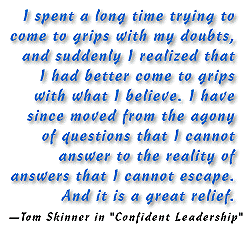
    Quote from Tom Skinner in 'Confident Leadership'
  15. Why have so many of history's greatest thinkers been believers? Have you ever wondered why thousands of intelligent scientists, living and dead, have been men and women of great faith?
    » Do real scientists believe in Creation? / Is the Bible completely accurate, or does it contain some inaccuracies about history and science?
  16. Isn't it somewhat arrogant to suggest that countless churches and people (including men like Abraham Lincoln) are all radically in error in their view of the Bible?
  17. How do you account for the origin of life considering the irreducible complexity of its essential components?
    » Learn more about the origin of life...
  18. How can the Second Law of Thermodynamics be reconciled with progressive, naturalistic evolutionary theory?
    » Second Law of Thermodynamics - Does this basic law of nature prevent Evolution?...
    How do you reconcile the existence of human intelligence with naturalism and the Law of Entropy?
  19. Why does the Bible alone, of all of the world's 'holy' books, contain such detailed prophecies of future events?
    » Learn more about the Bible...
  20. On what basis can the Bible (interpreted as per historic Christian orthodoxy) be challenged as a sole, final truth-standard (Galatians 1:8)?
  21. Is it absolutely true that "truth is not absolute" or only relatively true that "all things are relative?"
    » The Loss of Truth—Are we living in a moral stone age?...
  22. Is it possible that your unbelief in God is actually an unwillingness to submit to Him?
    » God's plan
    Quote from Mark Twain
  23. Does your present worldview provide you with an adequate sense of meaning and purpose?
  24. How do you explain the radically changed lives of so many Christian believers down through history?
  25. Are you aware that every alleged Bible contradiction has been answered in an intelligible and credible manner?
    » More about Bible contradictions...
  26. What do you say about the hundreds of scholarly books that carefully document the veracity and reliability of the Bible?
  27. Why and how has the Bible survived and even flourished in spite of centuries of worldwide attempts to destroy and ban its message?
    » Recommended resource: The Indestructible Book (video)...
  28. Why isn't it absurd to try to speak or even conceive of a non-existent 'God' when an existing God would, by definition, be greater?
  29. Have you ever considered the fact that Christianity is the only religion whose leader is said to have risen from the dead?
    » Is Christianity really unique among world religions?...
  30. How do you explain the empty tomb of Jesus in light of all the evidence that has now proven essentially irrefutable for twenty centuries?
    » Is the resurrection a myth? / Did Christ really rise from the dead? / Were the witnesses hallucinating?
  31. If Jesus did not actually die and rise from the dead, how could He (in His condition) have circumvented all of the security measures in place at His tomb?
    » Did Jesus really die? / How did Jesus die? / What is crucifixion?
  32. If the authorities stole Jesus' body, why? Why would they have perpetrated the very scenario that they most wanted to prevent?
    » Could Jesus' body have been stolen from the tomb?...
  33. If Jesus merely resuscitated in the tomb, how did He deal with the Roman guard posted just outside its entrance?
    » Could Jesus' have merely fainted? / Is the resurrection a myth? / Did Christ really rise from the dead?
  34. How can one realistically discount the testimony of over 500 witnesses to a living Jesus following His crucifixion (see 1 Corinthians 15:6)?
    » Maybe the witnesses were just seeing things?...
  35. If all of Jesus' claims to be God were the result of His own self-delusion, why didn't He evidence lunacy in any other areas of His life?
    » Is Jesus Christ's character consistent with his high claims?...
  36. If God is unchanging, wouldn't it be true that one who changes by suddenly “realizing” that he/she is “God” therefore isn't God?
  37. Is your unbelief in a perfect God possibly the result of a bad experience with an imperfect Church or a misunderstanding of the facts, and therefore an unfair rejection of God Himself? » Why should I consider Christianity, if all Christians are hypocrites? / What kind of world would you create? / How did bad things come about? / Why do the innocent suffer? /Does God feel your pain? / Goodness of God / Is God fair? / How can a God of love send anybody to Hell?
  38. How did 35-40 men, spanning 1500 years and living on three separate continents, ever manage to author one unified message, i.e. the Bible?
    » Can the Bible be infallible if it is written by fallible humans? / More about thecongruency of the Bible / The Discovering the Bible videos explain the amazing authorship of the Bible and many other evidences
  39. Would you charge the Declaration of Independence with error in affirming that "all men are endowed by their Creator..."?
  40. Because life origins are not observable, verifiable, or falsifiable, how does historical 'science' amount to anything more than just another faith system?
    » What is the nature of science and scientists? / Why do so many scientistsendorse Evolution? / Frequently asked questions on the Origin of Life
  41. What do you make of all the anthropological studies indicating that even the most remote tribes show some sort of theological awareness?
  42. Why subscribe to the incredible odds that the tilt and position of our planet relative to the sun are merely coincidental?
    » Consider: Was there a big bang?...
  43. If every effect has a cause, and if God Himself is the universe (i.e. is one with the universe, as some non-Christians suggest), what or who then caused the universe?
    » See our Creation SuperLibrary for answer about Creation/Evolution...
  44. What would be required to persuade you to become a believer?